SUMMARY OF THE DEVELOPMENT OF THE MILITARY-POLITICAL SITUATION IN THE WORLD IN 2025 IN THE CONTEXT OF UKRAINE’S NATIONAL INTERESTS
Part 5
Part V. Geopolitical Processes in the World and the Role and Place of the USA and China in Them
One of the main factors influencing the development of the situation around Ukraine and the Russian-Ukrainian war is considered to be general geopolitical processes. In particular, the formation of a new bipolar system of international relations with two leading centers of power – the USA and China.
As for Russia, it was effectively excluded from this system and began to lose even its regional positions. And when it failed to defeat Ukraine and stand up for its partners such as Syria, Iran, and Venezuela, it was not only no longer feared, but also began to be despised. Therefore, the situation in the world largely depends on the relationship between the USA and China. Although there have been positive changes in their relationship, there are also significant contradictions. Washington and Beijing have recognized that they are jointly responsible for the fate of the world. Besides, the USA has stopped making claims against China for violating democratic principles, to which China has reacted negatively.
The USA and China have also continued to compete for influence in the world and in individual regions, thereby disrupting the stability of the global and regional order. The USA began to lay claim to the entire Western Hemisphere, while China claimed Southeast Asia. This state of affairs did not cause any significant disagreements between them. However, problems began to arise later when the USA and China divided spheres of influence in the Asia-Pacific region and Eurasia. With regard to the Eurasian region, political scientists have noted that the USA seeks to “take away” Russia from China by restoring and developing bilateral cooperation with it. In other words, at least in expert assessments, Russia is no longer seen as a subject of international activity, but as an object of external influence. The same was true of the Russian-Ukrainian war, which China used to strengthen its position in competition with the USA and Europe, and the United States – to weaken Russia as the PRC’s largest partner.
During Donald Trump’s sharp intensification of the USA hegemonic course, as well as China’s activities, which opposed it with the idea of uniting around itself the countries dissatisfied with America, most of the regional leaders restrained their ambitions, which in a way weakened the contradictions between them. This was especially true since America began to openly use force to implement its plans. This is evidenced by the well-known US military operation to remove the current President of Venezuela and detain Russian tankers subject to sanctions. The USA may act in the same way towards other opponents, in particular Iran. China is not yet rushing to openly use force, but is demonstrating its power to Taiwan, whose territory it considers its own.
Against this background of global developments, the United Nations has finally lost its influence in preventing or resolving conflicts. The reason for this is fundamental disagreements between UN Security Council members, who in many cases were the instigators of these conflicts. In addition, Donald Trump’s actions have undermined the regulatory functions of the World Trade Organization and OPEC. International law has also effectively ceased to function. In other words, the world is undergoing fundamental changes, entering a new era of turbulence in international relations, where the law of force is beginning to prevail over the force of law. It is difficult to predict the consequences of such processes at this stage, but they will inevitably affect all countries, including Ukraine.
We have already discussed the US policy that has led to these trends. Therefore, let us take a closer look at what is known as China’s strategy.
In 2025, China continued to strengthen its position as a leading center of power, capable of establishing equal relations with the USA and defending its global and regional interests. Unlike Russia, it was quite effective in achieving its goals. The main directions of China’s foreign policy are as follows: establishing a mutually beneficial partnership with the USA within the framework of a bipolar world; strengthening the global and regional influence of the PRC while countering US hegemony; strengthening the PRC’s position in the Asia-Pacific region and the South China Sea; expanding strategic and economic ties with other countries; maintaining a firm stance on the “One–China Principle” and putting pressure on Taiwan by demonstrating military force.
As part of the practical implementation of these plans, Beijing agreed to a dialogue with Washington, initiated by Donald Trump. At the same time, it strongly rejected the latter’s attempts to impose unfavorable trade conditions on China. China became the only country that managed to defend its interests in the tariff wars initiated by the US President.
The temporary trade agreement concluded between the USA and China in July 2025 was a compromise in nature. Moreover, Beijing managed to defend the provisions that were strategically important to it. Despite the existing disagreements between the USA and China in trade and other areas, the signing of the agreement laid the groundwork for the resumption of political cooperation, which D. Trump had suspended during his first presidential term.
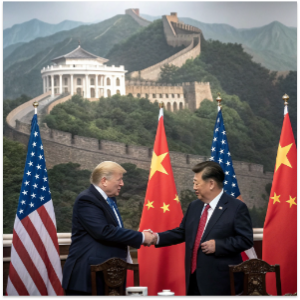
Earlier, we mentioned the meeting between the leaders of the USA and China on October 30, 2025, in South Korea on the sidelines of the Asia-Pacific Economic Cooperation summit. It was mainly devoted to trade and economic issues that needed to be agreed upon. However, key aspects of cooperation between the two countries in the political and security spheres were also discussed. Bilateral contacts are planned to continue during Donald Trump’s visits to China and Xi Jinping’s – to the USA this year.
At the same time, China has tried to counter the USA’s attempts to establish its dominance in the world. At the international level, Beijing promoted the principle of “global governance” as a counterweight, which provides for the prevention of the dominance of one state in the world or the unification of several countries under its auspices. In this regard, China advocated the adoption and implementation of strategic decisions in the field of world politics, economy, and security at the level of the UN or the G20. However, it has also begun to realize that these are ineffective.
At the same time, Beijing has continued to try to counterbalance Washington by consolidating around itself countries that have had problems in their relations with the USA and are interested in developing economic cooperation with China. This mainly refers to Russia and the countries of the so-called “Global South”, which includes Southeast Asia, the Asia-Pacific region, and South America. To this end, Beijing used mechanisms for cooperation with them in the formats of the SCO and BRICS+ international organizations. In recent years, China has confidently taken a leading position in those structures, which allows it to pursue its interests through them.
This was clearly demonstrated at the SCO summit in Tianjin, China, in September 2025. A notable feature of the event was the largest number of leaders of member countries in the history of the SCO who participated in it. This confirmed China’s role and importance as a leading power in the world and leader of the “Global South”. The main items on the agenda were determining the global development vector of the association, which affects the interests of more than 20 countries. Together, they cover 67% of Eurasia and about 3.5 billion people (almost half of the world’s population), and their economic weight accounts for 19-25% of the world’s total. The summit did not have an anti-Western orientation, demonstrating the PRC’s desire as the leader of the organization to establish constructive relations with the USA and Europe.
At the same time, China continued to implement its strategic initiative “One Belt, One Road”, which envisages the creation of a single economic space from Southeast Asia to Europe with the involvement of other regions. In 2025, China’s activities under the initiative were characterized by a record increase in investment in African and Central Asian countries. In the first half of last year alone, Chinese businesses invested $124 billion in various projects. The increase in freight traffic on the China-Europe and China-Central Asia routes is evidence of the active cooperation between the initiative’s participants.
China also actively participates in the work of regional organizations involving the countries of the “Global South”, first of all the Asia-Pacific Economic Cooperation (APEC) and the Association of Southeast Asian Nations. In November 2025, Chinese leader Xi Jinping joined the APEC summit in South Korea.
Europe remains one of China’s largest trading partners and is therefore important to China. In 2025, total trade between China and the EU grew by about 5% to EUR 731 billion. However, the trade imbalance between them also increased. Chinese exports to the EU grew by 8.5% (especially in cheap clothing and electronics), while European exports to China fell by 1.4%.
The development of cooperation between China and Europe was facilitated by Donald Trump’s policy. It pushed them away from the USA, forcing them to diversify their trade and economic ties. In addition, amid the USA’s “flirtation” with Russia, EU leaders tried to involve China in putting pressure on Moscow to end the war against Ukraine. In particular, President of France E. Macron visited China in December 2025 for this purpose.
However, the level of interaction between China and Europe was lower than in the second half of the 2010s and early 2020s, which was a consequence of the actions of the EU leadership and leading European countries to protect national producers. In 2025, the problem became even more acute due to the growing trade imbalance between the EU and China. To level the playing field, the European Commission began reviewing customs rules for Chinese goods.
Russia occupies a special place in China’s policy. At the official level, Beijing has demonstrated its friendly attitude towards Russia as a strategic partner. At the same time, its support for Russia has been minimal. This is because it has been trying to use Russia to further its own interests. This is discussed in more detail in the third section.
To the PRC’s specific actions towards Russia mentioned there, we can add the intensification of the topic of the so-called “Northern Territories” in the Chinese political and information space. With the spread of the current crisis in the RF, which has created a threat of its disintegration, the number of publications in the Chinese media about the need to revise the border between the two countries has increased.
The Chinese leadership’s efforts to strengthen the PRC’s position in the world were backed up by measures to enhance its military potential. The main areas of development of the People’s Liberation Army (PLA) remain: increasing the number of nuclear weapons and their delivery systems, first of all of modernized silo-based ICBMs; the use of new ships and submarines, including new-generation nuclear submarines; increasing the share of combat aircraft built using stealth technology; developing space for military purposes; developing and adopting hypersonic missiles; replacing the outdated fleet of land forces combat equipment; and massively introducing computer technologies and UAVs.
China is determined to achieve military parity with the USA by 2050. The PLA’s potential was demonstrated during a parade in Beijing on September 2, 2025, dedicated to the 80th anniversary of the end of World War II. About 12,000 military personnel were involved in the event, and modern armored vehicles, aircraft, missile systems, and unmanned aerial vehicles were demonstrated. This sent a signal about the PRC’s readiness and ability to resolutely defend its security interests.
However, against this background, the economic situation in China appears to be complicated. In 2025, the country’s GDP growth rate fell to about 4.5% from 5% in 2024. This was due to the negative impact of the USA’s tariff wars on the global economy and directly on China, as well as the country’s internal problems. These include the crisis in the real estate market, a decline in consumer demand, and an increase in regional and local budget deficits.
The Chinese government’s strategy for addressing these issues includes: switching to a new model, namely prioritizing qualitative development, innovation, and high-tech manufacturing rather than simply accelerating growth; stimulating domestic consumption by promoting an increase in household income; supporting key sectors of the economy, primarily automotive manufacturing (in particular, electric vehicles), shipbuilding, the aerospace industry, and rail transport.
So far, economic problems have not had a critically negative impact on the PRC. However, their further intensification could cause socio-political instability in the country. In this case, it is quite possible that Beijing will try to divert the population’s attention from internal problems by reorienting itself toward external expansion. And its logical direction, so to speak, will be Russia, which is quite possible, given its current state.
The world is finally taking on a bipolar form with two leading centers of power, the USA and China. They are aware of their shared responsibility for the fate of humanity, but they also have a number of significant differences. So far, they have refrained from direct confrontation and have divided the world into spheres of influence in political and economic terms. However, the USA is increasingly inclined to use force to achieve its goals. China may follow suit. As a result, the world is becoming more dangerous, where only the truly strong can survive.
Yurii Mykhailenko
Institute for Global Politics
(Image generated by neural network)